
Writing Made Visible
Books. Booze. Beats.

Books.
Something a little different this month? I know I usually recommend horror, but instead I’m going to recommend a work of nonfiction that I think is worthy a read for anyone who writes, teaches, or cares about writing: John Warner’s More Than Words: How to Think About Writing in the Age of AI. It’s an engaging look at what writing is (and isn’t) and what is fundamentally lacking in the text created by generative AI.
Yes, I still have AI on the brain. It’s hard not to. Anthropic recently settled their class-action lawsuit (I’ve got one eligible book in the database), and the one against OpenAI is moving ahead. Plus, all my work lately is kind of about AI.
Much of my recent writing work has been related to research rather than fiction. I’m taking an online graduate certificate right now in Literature & Language as part of my sabbatical, and now that it’s research paper season again, I get to be on the student side of things for a change. Yes, it’s more fun (for me—I’m a weirdo) to do research projects than it is to grade them. My big project is about Critical AI Literacy in first year composition. Part of the paper discusses making the writing process visible, as it is so often obscured, especially for students. So in the interest of practicing what I preach, here I am making my process visible at the kitchen table:
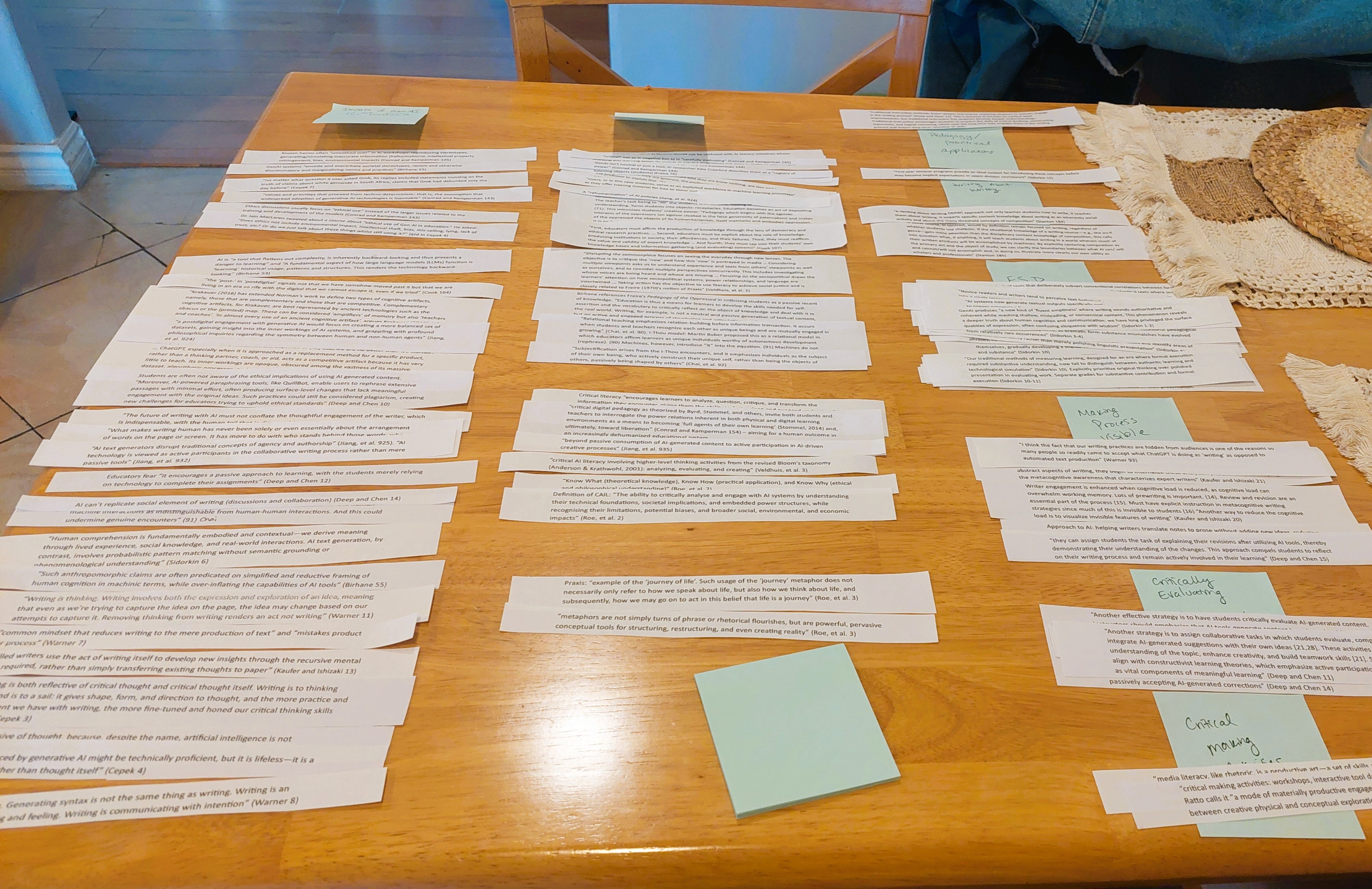
After going through all my sources and pulling out specific passages I might want to quote or reference, I had a full 10 pages of source material, which was a bit much for my usual organization method of cut-and-paste into grouped chunks on MS Word. I decided to print it all out and cut up each individual passage so that I could move things around. I started with my three main sections for the paper, with one of these naturally dividing into sub-sections (marked by post-its), and then I grouped and ordered until I had the material the way I wanted it. (Not pictured: me taping these strips together into sheets to carry back to my computer in the other room)
Remember, though, this is literally just quotations from my sources. I still had to actually, you know, write. But with my evidence all in the right order, it’s a much faster process. I pretty quickly knocked out the first 1,600 words by writing the context, analysis, and connective tissue between the source material.
If only I could figure out such an efficient method for writing a book! No, don’t tell me to ask AI to do it for me.
Writing novels can be a messy process, and I think The Midnight Muse was probably the messiest process of any book I’ve written yet. Like the mycelium that threads through the forest floor, its creation was a rhizomatic experience.
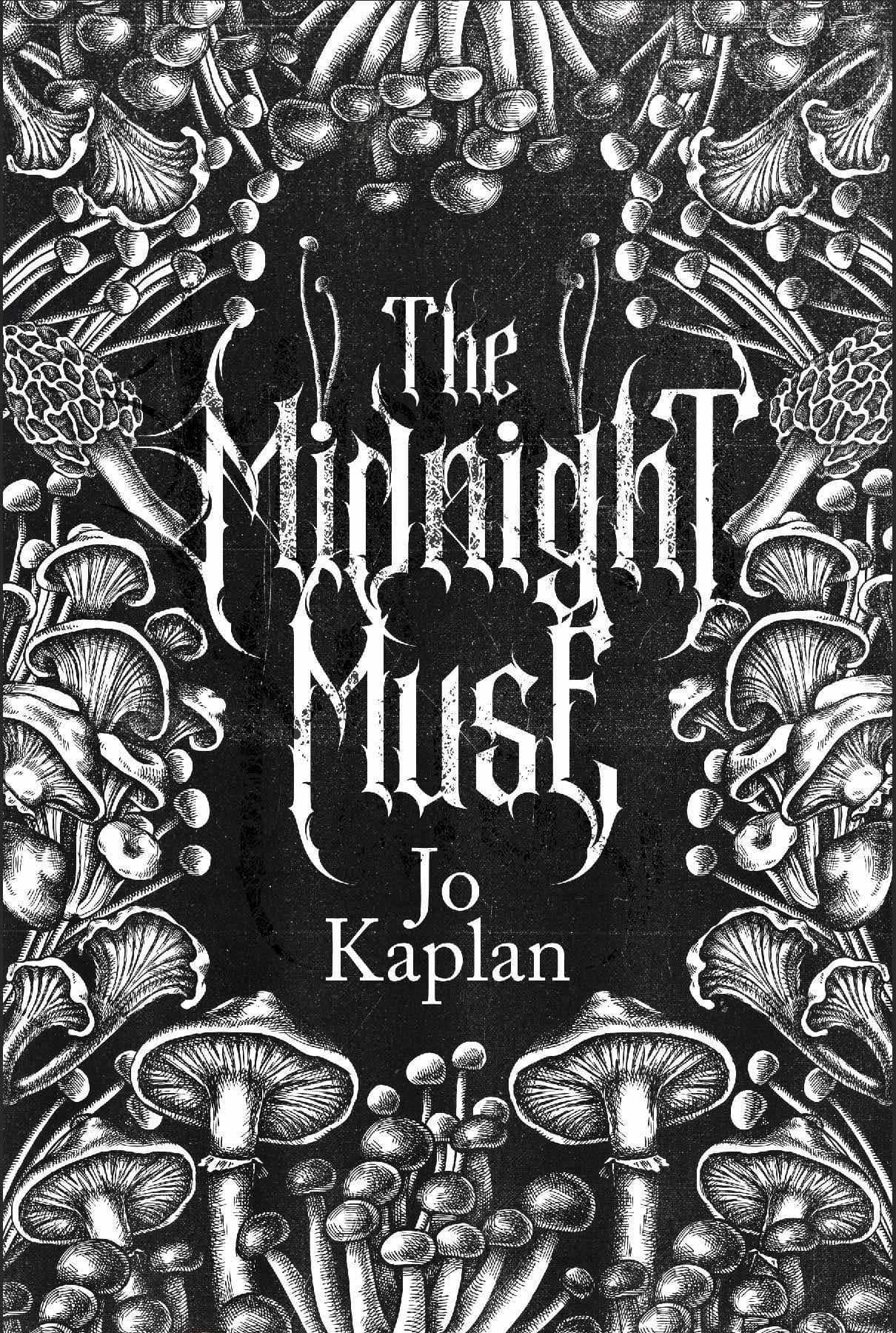
I wrote the first draft—or it may be more apt to call it the zero draft—in November of 2021. It was the first and only time I ever attempted NaNoWriMo. I succeeded, at least as far as the contest goal goes, which is to write 50,000 words in a month. But “succeeded” seems a strange way of looking at it, considering I completely dumped that entire manuscript and restarted from scratch, changing all of the characters, the context, and, frankly, most of what happens. What remained was setting, concept, and some very broad strokes. Oh, and I guess there was a Jacqueline in the zero draft. There’s a Jacqueline in the finished book, too, but I can’t remember if the original Jacqueline had anything to do with the one in The Midnight Muse beyond the name. I didn’t even remember this except that I just opened that original document, having forgotten nearly everything about it.
Over the next few years, I wrote the new version, and revised it, and revised it, and revised it. Characters changed again. Other layers were built in. It’s now four years later, and the finished book will finally be published in March. Would I revise it again if I had the chance? Yes, don’t even ask. Am I glad to finally unleash it onto the world and, maybe, hopefully, get through the next one if my creativity and motivation will get me in gear? Absolutely. That motivation can hit me any day now, if the muses are listening. (But not the one in Midnight Muse. She’s scary.)
Luckily, not all of my research work right now is as intense as my 20-25 page AI project. In another class, I got to present my research as a PowerPoint, so, naturally, I wasted a lot of time getting my slide design just right.
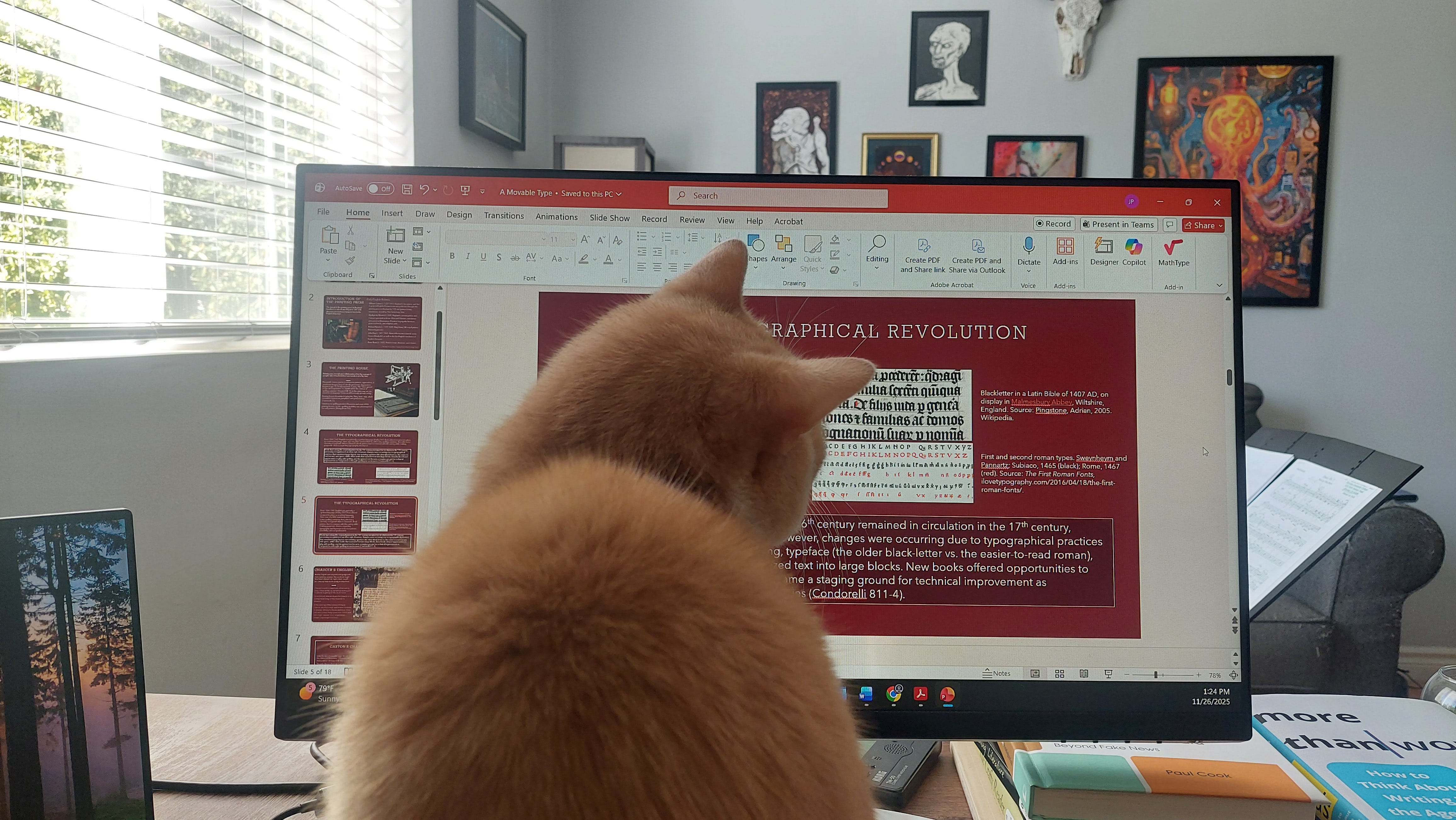
One out of one cats agree it’s the best PowerPoint they’ve ever seen. Funny, because it’s about the influence of the printing press on English orthography, and I’m pretty sure cats can’t read. (catch a glimpse of More Than Words hanging out on my desk)
Booze.
I was searching for a writing-themed cocktail to pair with More Than Words, and I’m sure there are many (writers aren’t exactly known for their sobriety), but what came to mind was a deeply human drink in a deeply human book. Jack Kerouac may be best known for On the Road, but in Big Sur, the main character—clearly an alter-ego of Kerouac’s—spends much of his time slugging port wine. He is clearly an alcoholic, and for that reason, the port really stuck with me, even though it’s been years since I read the novel. Of any liquor an alcoholic might choose… port? Really? It’s sweet and heavy, really more of a dessert than anything else. But there is something so human about this choice. He knows it’s loaded with sugar (and, obviously, alcohol), and it’s going to make him feel bad in the morning, but he drinks it anyway.
And it’s idiosyncratic. I can’t imagine an AI deciding to have its alcoholic character drink mostly port. Humans are weird. GenAI is almost annoyingly not-weird (because its output is based on an aggregation of the most common patterns available, but I digress).
And I’m weird. And I like port.
But please don’t chug a whole bottle.
Look, I know you come here for cocktail recipes, so here’s one for you that incorporates our good, weird port:
Port Old Fashioned
Ingredients
2 oz rye whiskey
1oz port wine
2-3 dashes orange bitters
Directions
Pour all ingredients over ice and give it a stir.
Beats.
No band news right now, but the set for my upcoming orchestra concert is excellent, and why not listen to some classical music with your Warner and your port?
For the concert, we’ve got Vivaldi (the metal of the Baroque period), de Falla’s Three Cornered Hat, a modern piece about aliens, and the rambunctious Romanian Rhapsody by Enescu. As a listener, I adore this piece. As a cellist, eh… unfortunately, the cello part is painfully dull (I think Enescu might hate us almost as much as Pachelbel), but it’s such a fun piece overall that it’s hard to much care.
There’s this teeny bit that also makes me think of Beetlejuice: certainly the same vibe, at least. Am I crazy? Let me know if you hear it (around 7:40 in the linked video).
Okay, now I want to play the music from Beetlejuice. That actually sounds really fun.
About Me
Jo Kaplan is a Shirley Jackson Award nominated author whose work has been described as “immersive, chilling, and compelling” by Library Journal and “delightfully creepy” by Booklist. She is the author of It Will Just Be Us, When the Night Bells Ring, and The Midnight Muse, as well as short stories which have appeared in publications such as Fireside Quarterly, Black Static, Nightmare Magazine, and award-winning anthologies. In addition to writing, she teaches English and creative writing at Glendale Community College and is the co-chair of the Horror Writers Association’s Los Angeles chapter. She also plays cello in both the Symphony of the Verdugos and the indie Spanish rock band Guerra/paz. Find her at jo-kaplan.com.